

Daily: Semiconductor tariffs; Foundry landscape in 2030; Samsung's Taylor fab
5.5 min read.

Highlights
Semiconductors tariffs. I’ve written in the past about how semiconductor tariffs are chugging along on their own timeline, distinct from any of the ‘reciprocal tariffs’ or other levies. They’re going through a congressional Section 232, which holds more legal validity than executive orders, but take a lot longer.
In the latest development, the Trump administration has conducted public consultations with related stakeholders and the backlash is severe. Chip companies, auto companies, industry groups, foreign nations, all do not want tariffs on semiconductors. The number that is being floated is 25%. Given chips are integrated into every facet of contemporary society, it would be wildly inflationary – almost like a 25% tariff on oil.
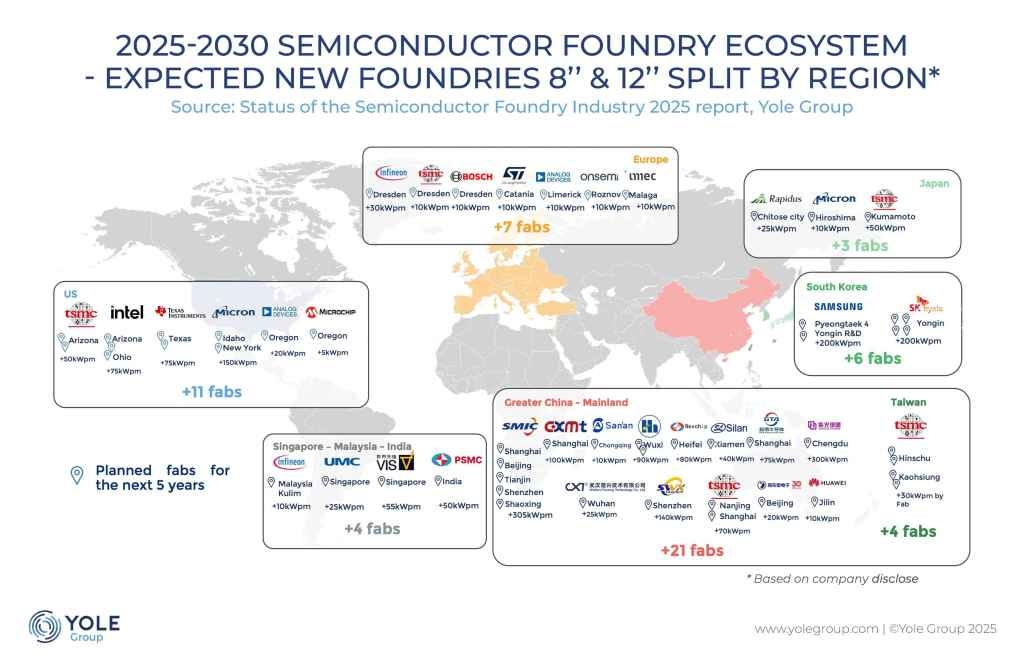
Foundry landscape in 2030. Yole Group, a semiconductor research firm, has published its latest report on the state of the foundry. It expects Mainland China to lead foundry capacity by 2030, with 30% of the global share. I would caveat that that would depend on chip export controls placed by Washington (and maybe allies), domestic development of chipmaking equipment (esp in EUV photolithography), and domestic industry dynamics that will trend toward consolidation.
Samsung’s Taylor fab. Samsung’s Taylor, TX fab moves along despite delays. It’s 2nm equipment will likely be installed in 2026. Samsung is also looking to hire U.S.-based managers for its foundry division. The initial aim for the Taylor fab was 2024 but has had delays over the years. Moving manufacturing into the U.S. is neither quick nor simple!
Thanks for reading.
1. Policy and Geopolitics
1.1
Bloomberg (06/25): Trump’s Chip Tariff Threat Sparks Pushback From Auto Industry to Tech
Blowback to President Donald Trump’s idea of tariffs on imported semiconductors is proving to be broad and deep, stretching from auto companies and boat makers to the technology industry and crypto enthusiasts, according to a review of more than 150 public comments on the proposal.
The possible levy of up to 25% has united rivals like Tesla Inc., General Motors Co. and Ford Motor Co. in voicing reservations. It’s brought together industry lobbies from the Crypto Council for Innovation to the National Marine Manufacturers Association. Even Taiwan and the People’s Republic of China are finding common cause, along with predictable parts of the tech sector including chipmakers and wireless providers.
1.2
Nikkei (06/24): Chipmaker Melexis bets on Malaysia's 'neutrality' to power China growth
Belgian chipmaker Melexis is leveraging its production capacity in "neutral" Malaysia to navigate the geopolitical headwinds buffeting the global semiconductor industry, with an eye toward sharpening its China strategy.
Marc Biron, chief executive of Melexis, told Nikkei Asia that the uncertainties surrounding the global chip supply chain are pushing companies to become "agile enough" to seize emerging opportunities, particularly by building out a "China for China" model.
2. Economy, Finance, and Business
2.1
AnySilicon (06/24): Semiconductor foundry landscape to transform by 2030
Foundry capacity is forecasted to grow at 4.3% CAGR from 2024 to 2030.
Mainland China to lead in foundry capacity by 2030, with 30% of global share.
U.S. players account for 57% of wafer demand but own only 10% of foundry capacity.
Global foundry utilization to remain at about 70%, with growth heavily dependent on demand.
Yole Group unveils its latest Status of the Semiconductor Foundry Industry report, offering a comprehensive view into a sector undergoing profound transformation. At the crossroads of technology, geopolitics, and global market dynamics, this ecosystem is being reshaped by new capacity investments, regional power shifts, and long-term national strategies.
2.2
Korea Economic Daily (06/24): Samsung on hiring spree to bolster US foundry sales
Samsung Electronics Co. is on a hiring spree for senior sales managers in its foundry business, offering generous compensation packages, as it goes all-in to secure large contract chipmaking orders from US Big Tech firms.
Following the March appointment of ex-TSMC sales executive Margaret Han to lead its US foundry unit in March, Samsung Foundry has posted senior sales manager positions on its website.
2.3
EE Times (06/23): SambaNova Shifts To Inference, Courts Cloud Customers
SambaNova is refocusing away from training as the industry shifts its focus to inference workloads, CEO Rodrigo Liang told EE Times.
“The industry has shifted to primarily inference,” he said. “Everyone is waking up to the fact that inference is going to be the focus for the next few years, and we’re going to make sure we’re attacking that.
The company laid off 77 people in April as part this refocus. Liang said it was necessary to deploy capital and resources where the market is growing, which today is inference workloads.
2.4
Bloomberg (06/25): Chip Designer Ambarella Explores Potential Sale
Chip design company Ambarella Inc. is considering options including a potential sale, according to people familiar with the matter.
Ambarella, which is working with bankers, has reached out to potential buyers, said the people, who asked not to be identified discussing private information. The company’s shares rose 21% on the news, giving it a market value of about $2.6 billion.
Santa Clara, California-based Ambarella could appeal to chip rivals interested in bulking up their automotive portfolio, the people said. Some private equity firms could also show interest, they added.
2.5
Bloomberg (06/24): Jensen Huang Starts Selling Nvidia Stock Under $865 Million Plan
Nvidia Corp. Chief Executive Officer Jensen Huang has started selling the chipmaker’s stock, his first transactions under a plan that allows him to offload up to $865 million worth by year’s end.
Huang disposed of 100,000 shares over a two-day period of June 20 and June 23 for $14.4 million, according to a filing Monday with the Securities and Exchange Commission. Huang’s sales are part of a new 10b5-1 plan adopted in March and disclosed last month in Nvidia’s quarterly report.
Huang is the world’s 12th richest person with a $126 billion fortune, which is almost entirely made up of Nvidia shares, according to the Bloomberg Billionaires Index. The CEO has sold more than $1.9 billion in Nvidia stock, according to index calculations.
3. Technology
3.1
TrendForce (06/24): Samsung Reportedly Resumes Cleanroom Work at Taylor in Q2; 2nm Tool Move-In Targeted for 2026
Samsung is reportedly stepping up preparations for production at its U.S. foundry. According to South Korean outlet ZDNet, citing sources from June 23, the company is discussing plans to begin installing equipment for its 2nm process at the Taylor fab in 2026.
When Samsung’s Taylor investment was first announced in late 2021, production was initially scheduled for 2024—but the timeline has since been pushed back multiple times, according to South Korean media outlet The Elec. Due to ongoing delays, the city has reportedly revised its financial incentive agreement, scaling back support for the project, Korea JoongAng Daily notes.
3.2
TrendForce (06/24): Fujitsu Taps TSMC for 2nm CPU, But Flags Rapidus as Key to Supply Chain Diversification
According to MoneyDJ, citing Nikkei, Fujitsu is developing a 2nm CPU named “MONAKA” based on designs from Arm. The chip is scheduled for commercialization in 2027 and is intended for AI and data center applications.
A higher-performance successor is planned for the next-generation supercomputer Fujitsu is co-developing with RIKEN. The report highlights that Fujitsu plans to outsource manufacturing of these chips to TSMC.
3.3
Korea Economic Daily (06/24): LS Electric poised to join Nvidia's supply chain via Vertiv deal
LS Electric Co., a South Korean industrial system supplier, is poised to deliver a large volume of power control equipment, including switchgears and circuit breakers, to Vertiv Co., a leading provider of liquid-cooling solutions used in Nvidia Corp.'s AI servers.