

Weekly: A CFR primer on Section 232 tariffs
6 min read.

Highlights
CFR on Section 232 tariffs. The Council of Foreign Relations comes out with timely data and explanation of the Section 232 sectoral tariffs that are expected to come into affect later this month. Semiconductors are expected to be one of the major goods targeted, alongside pharmaceuticals, auto, and steel. However much the tariffs will be, they will affect major suppliers, including China, Taiwan, and Korea.
China builds data centres. Bloomberg’s Big Take does a graphical story on China’s effort to build AI data centres on its soil. The major data centres are expected to be built in Xinjiang, in China’s western desert region. The data centres are being constructed with the assumption that they would be filled with tens of thousands of Nvidia AI chips, namely H100 and H200. But U.S. sanctions are designed to prevent currently all of Nvidia’s AI chips from entering China.
Nvidia CEO Jensen Huang says that Nvidia is complying by the rules, but U.S. government estimates suggest there are Nvidia chips in China, though there is no consensus on how many. While it is unclear if or where Chinese data centres will get their chips, the construction moves along.
AI strategy for business. For readers in business, the FT produced a long article on the factors a business must think about when implementing an AI strategy. The article argues that AI strategies must be implemented deliberately and judiciously, and lays out a series of considerations, including AI hardware, on-site/off-site data centres, cloud services, data sovereignty regulations, and more. A useful guide for executives strategising AI.
Thanks for reading.
Table of Contents
Shannon K. O'Neil, Julia Huesa, and Gabriela Paz-Soldan, “A Guide to Trump’s Section 232 Tariffs, in Nine Maps,” CFR, 07/10/2025.
Andy Lin, Mackenzie Hawkins, Colum Murphy, and James Mayger, “China Wants 115,000 Nvidia Chips to Power Data Centers in the Desert,” Bloomberg, 07/09/2025.
Lucy Colback, “Why it is vital that you understand the infrastructure behind AI,” FT, 07/07/2025.
1.
Shannon K. O'Neil, Julia Huesa, and Gabriela Paz-Soldan, “A Guide to Trump’s Section 232 Tariffs, in Nine Maps,” CFR, 07/10/2025.
Section 232 tariffs aim to protect U.S. national security. Created by the Trade Expansion Act of 1962, Section 232 empowers the president to charge duties pending the results of a Department of Commerce investigation into the imports’ effects on national security. The Trump administration has already used this tool to raise levies on aluminum, cars, car parts, and steel, and has launched 232 investigations into seven other types of products.
Semiconductors
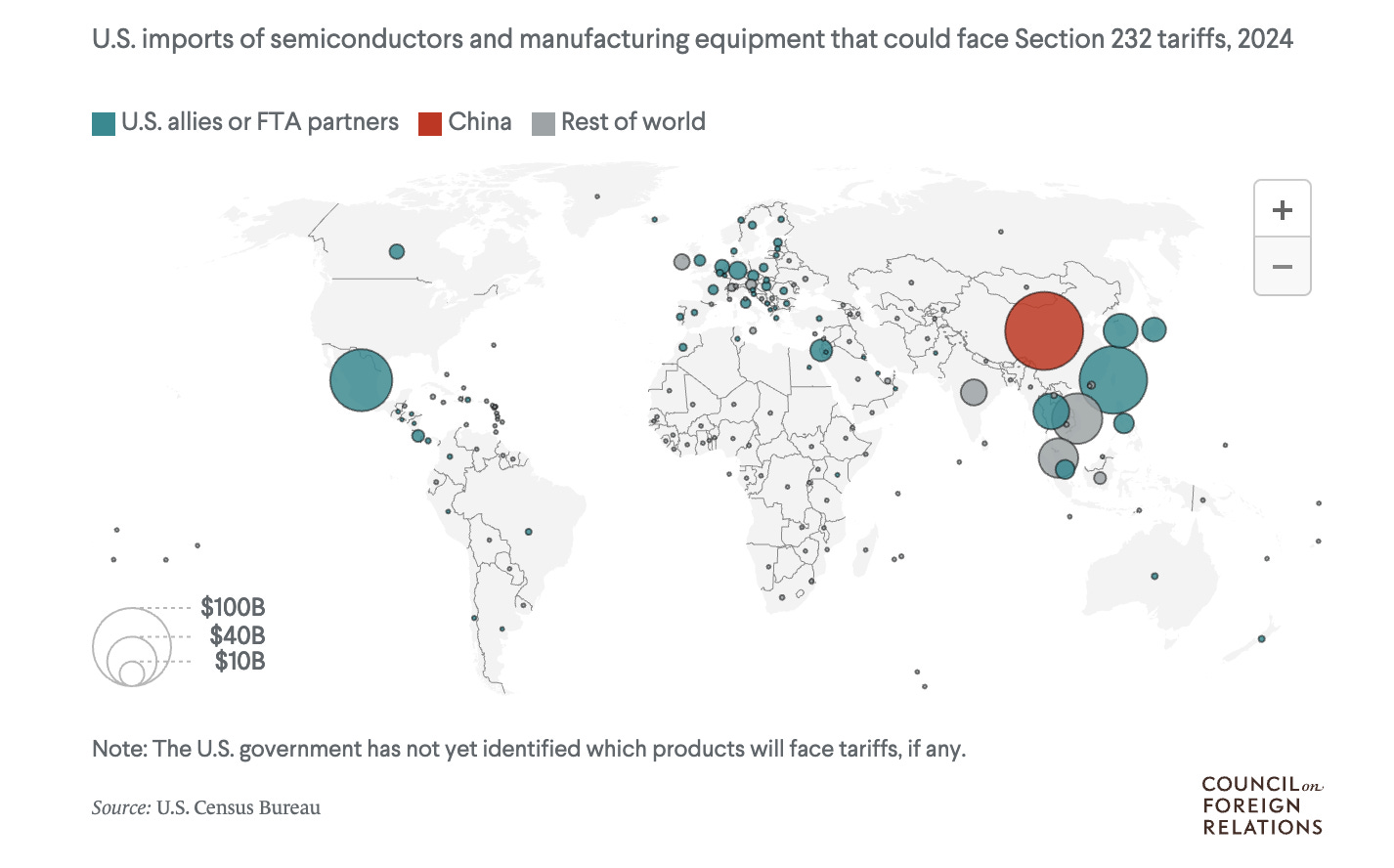
The Trump administration is reviewing whether to impose tariffs on semiconductors, the equipment used to manufacture them, and the products made with them.
The United States relies heavily on foreign suppliers for these goods, importing over $200 billion more than it exported in 2024. And while Washington is working to ramp up domestic semiconductor production through subsidies provided in the 2022 CHIPS and Science Act due to national security concerns, it still relies on imported chips, as well as imported material and chemical inputs. It also depends on testing and packaging abroad, often importing or reimporting its final chips.
Imports are highly concentrated, with five countries providing nearly 80 percent of U.S. semiconductor-tied imports. China tops the list, supplying more than a quarter of imports. It leads assembly, testing, and packaging (ATP) globally, and is home to nearly a third of ATP facilities, including for many U.S.-owned firms. Taiwan supplies almost one fifth of U.S. imports, sending both wafers and finished chips. Mexico ranks third, holding steady at 15 percent over the past decade, though that may rise as Taiwan-based electronics manufacturer Foxconn brings new ATP capacity online as soon as late 2025 or early 2026.
2.
Andy Lin, Mackenzie Hawkins, Colum Murphy, and James Mayger, “China Wants 115,000 Nvidia Chips to Power Data Centers in the Desert,” Bloomberg, 07/09/2025.
There’s a construction boom under way on the edge of the Gobi desert in Xinjiang, where cranes are at work in fields of rock and the sound of jackhammers fills the air.
Here in the modest county of Yiwu, China is building out its ambitions to lead the world in artificial intelligence.
The futuristic structures are data centers that the operators seek to equip with high-end American semiconductors — chips that the US government doesn’t want its geopolitical rival to obtain.
A Bloomberg News analysis of investment approvals, tender documents and company filings shows that Chinese firms aim to install more than 115,000 Nvidia Corp. AI chips in some three dozen data centers across the country’s western deserts. Operators in Xinjiang intend to house the lion’s share of those processors in a single compound — which, if they can pull it off, could be used to train foundational large-language models like those of Chinese AI startup DeepSeek.
The complex as envisioned would still be dwarfed by the scale of AI infrastructure in the US, but it would significantly boost China’s computing prowess as President Xi Jinping pushes for technological breakthroughs. Such a project also would raise serious concerns for officials in Washington, who restricted leading-edge Nvidia chip sales to China in 2022 over worries that advanced AI could give Beijing a military edge.
Yet the Chinese documents contain no explanation of how companies plan to acquire the chips, which cannot be legally purchased without licenses from the US government, permits that haven’t been given. The companies listed in the filings, state officials and central government representatives in Beijing declined to comment when asked to explain.
To gauge whether Chinese entities could realistically procure that quantity of restricted processors, Bloomberg News spoke with more than a dozen people who’ve been involved in or privy to US government investigations into the matter, as well as several people with direct knowledge of the black market in China.
3.
Lucy Colback, “Why it is vital that you understand the infrastructure behind AI,” FT, 07/07/2025.
Businesses have yet to understand that a successful AI strategy is “no longer a tech decision made in a tech department about hardware”, says Mackenzie Howe, co-founder of Atheni, an AI strategy consultant. As a result, she says, nearly three-quarters of AI rollouts do not give any return on investment.
“If they want to leverage AI properly — which means going after best-in-class tools and much more tailored approaches — best in class for one function looks like a different best in class for a different function,” Howe says. Not only will the choice of AI application differ between departments and teams, but so might the hardware solution.
Although this report will focus on AI hardware decisions, companies should bear in mind the first rule of investing in a technology: identify the problem you need to solve first. Avoiding AI is no longer an option but simply adopting it because it is there will not transform a business.
Infrastructure is therefore key: specifically having the right infrastructure for the problem you are trying to solve. “You can have an unbelievably intelligent AI model that does some really amazing things, but if the hardware and the infrastructure is not set up to support that then you are setting yourself up for failure,” Dietz says.
When it comes to data servers and their locations, companies can choose between owning infrastructure on site, or leasing or owning it off site. Scale, flexibility and security are all considerations.
Companies that cannot afford or do not wish to invest in their own hardware can opt to use cloud services, which can be scaled more easily. These provide access to any part or all of the components necessary to deploy AI, from GPU clusters that execute vast numbers of calculations simultaneously, through to storage and networking.
Another consideration when assessing data centre options is the need to comply with a home country’s rules on data. “Data sovereignty” can dictate the jurisdiction in which data is stored as well as how it is accessed and secured. Companies might be bound to use facilities located only in countries that comply with those laws, a condition sometimes referred to as data residency compliance.
-