

Weekly: After the AI Diffusion Rule; Has Huawei caught up?; Hank Paulson on the AI energy challenge
9 min read.

Highlights
After the AI Diffusion Rule. An excellent piece in the Carnegie Endowment for International Peace, which rightly foresaw Trump scrapping the AI Diffusion Rule, leading to a very timely piece on what Washington may do next. It goes through the menu of policy options systematically, and concludes that “policymakers’ best bet is to pursue some version of a country tier framework,” with some changes like “favorable treatment to major U.S. partners like India, Israel, and Poland; doing more to crack down on smuggling to China; and using chips as leverage to cut smart deals with geopolitical swing states.”
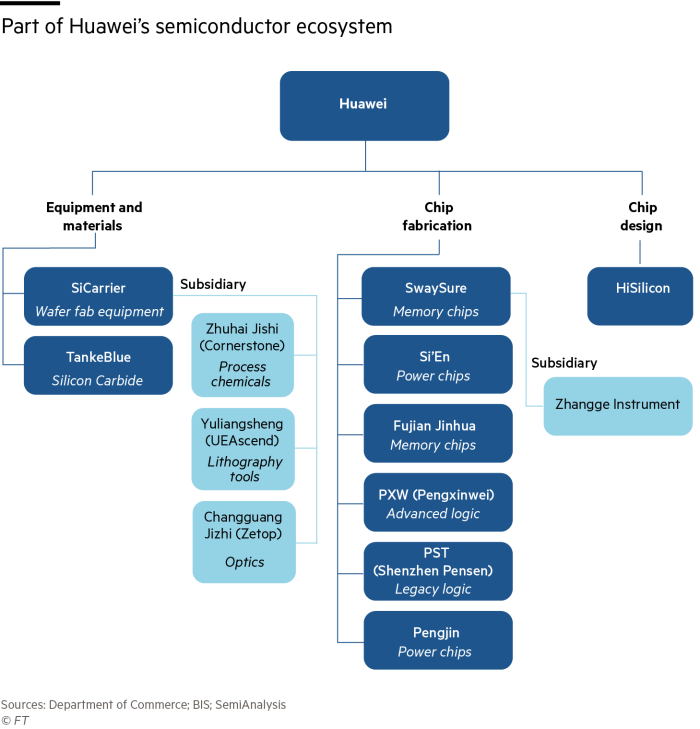
Has Huawei caught up? Two pieces in the FT and one in The Economist on Huawei. The FT piece unveils the web of Huawei semiconductor subsidiaries, some of which are public and others that Huawei has previously denied. The conclusion of the three pieces: it’s getting harder to say that China is ‘behind;’ China has basically fully caught up.
Hank Paulson on the AI energy challenge. Former Treasury Secretary Hank Paulson writes in the FT on the energy challenge that AI poses. He writes, “The US must develop and deploy a clear-eyed national energy strategy that prioritises speed, flexibility and cost-effectiveness… The right answer isn’t to choose one energy source over another, but to create, quickly, the conditions for scaling up what works.”
Thanks for reading.
Table of Contents
Alasdair Phillips-Robins and Sam Winter-Levy, “The Trump Administration May Be About to Repeal the AI Diffusion Rule. Here’s What It Should Do Next.,” Carnegie, 05/08/2025.
The Economist, “Huawei and other Chinese chip firms are catching up fast,” The Economist, 05/08/2025.
The Economist, “How China is still getting its hands on Nvidia’s gear,” The Economist, 05/05/2025.
Eleanor Olcott, Zijing Wu, Chris Cook, “Satellite images reveal Huawei’s advanced chip production line in China,” FT, 05/04/2025.
Hank Paulson, “Hank Paulson: Clean energy will be critical to winning the AI race with China,” FT, 04/27/2025.
1.
Alasdair Phillips-Robins and Sam Winter-Levy, “The Trump Administration May Be About to Repeal the AI Diffusion Rule. Here’s What It Should Do Next.,” Carnegie, 05/08/2025.
This article considers a broad range of options to help frame the debate and highlight the trade-offs involved. Ultimately, it argues that however the new administration designs its replacement for the diffusion rule, policymakers’ best bet is to pursue some version of a country tier framework, although with a series of changes to Biden’s proposal, including giving more favorable treatment to major U.S. partners like India, Israel, and Poland; doing more to crack down on smuggling to China; and using chips as leverage to cut smart deals with geopolitical swing states.
Each of the other options would come with serious risks. If the administration leans too far toward control, it will cut U.S. tech companies off from major foreign markets and likely slow the pace of AI development, worsening the U.S. trade balance and jeopardizing America’s AI lead.
Meanwhile, if policymakers largely remove controls on exports to countries other than China, they will enable continued large-scale chip smuggling and accelerate the offshoring of a core strategic technology to a set of countries, including the Gulf states, that do not share the United States’ interests.
Finally, if the administration attempts to avoid an overarching global framework and instead win leverage in a series of bilateral deals, it will find itself bogged down in dozens of negotiations and thousands of licensing decisions that it lacks the bureaucratic capacity to handle. The result will be either lopsided deals that give away valuable technology in exchange for illusory trade concessions or a logjam in which, by accident rather than design, the U.S. government turns off exports of one of its most important technologies.
2.
The Economist, “Huawei and other Chinese chip firms are catching up fast,” The Economist, 05/08/2025.
A wave of optimism has lately swept through China’s chip industry. Share traders in Shanghai joke that Cambricon, a local firm, not only offers a substitute for Nvidia’s processors, but for its stock, too. Although the Chinese semiconductor firm is worth but a fraction of its giant American rival, its share price has rocketed by 350% over the past year, around 15 times as much as Nvidia’s.
Despite America’s efforts to hold it back, however, Chinese AI continues to power ahead. At least for the time being, the country’s AI labs do not appear to be suffering from a shortage of chips. Internet giants such as Alibaba and Tencent are building vast numbers of AI data centres, apparently unimpeded.
Yet China’s own chipmakers are also accomplishing feats that seemed out of reach just a few years ago. Huawei, a Chinese tech giant, has impressed analysts with the new CloudMatrix chip cluster it began delivering last month. By stitching together 384 of its Ascend AI chips using advanced networking technology, it is reportedly able to outperform Nvidia’s popular NVL72 cluster, though it consumes more power, too. Could China in time shake off its dependence on foreign semiconductor technology altogether?
China’s chip industry still has some way to go. Most of the companies buying locally made chips are believed to be state-owned enterprises. Huawei’s latest AI processor, called the Ascend 910C, still contains many components supplied by foreign firms, according to SemiAnalysis, a consultancy.
Another problem for China is the software used by coders to program chips. Nvidia’s platform, called CUDA, is still by far the best in the world. Nearly all AI developers learn how to use it. And it works only with Nvidia’s chips. Switching to an alternative is costly, because it pulls developers out of an enormous network of fellow users that can help solve problems. Huawei has created a substitute for CUDA, called CANN, which coders can use for its Ascend chips. But the software is years behind Nvidia’s, and it is riddled with bugs. It has reportedly been met with apathy by local techies.
3.
The Economist, “How China is still getting its hands on Nvidia’s gear,” The Economist, 05/05/2025.
The trouble for America is that restricted Nvidia chips continue to make their way into the hands of Chinese AI developers. A shadowy supply chain has emerged, designed to work around sanctions. Some customers lease access to offshore data centres; others buy chips through murky intermediaries. Further attempts to curb the flow of chips are likely to suffer from many of the same problems.
To see why it is so difficult to restrict access to AI chips, consider Johor, a part of southern Malaysia once better known for its palm-oil plantations. Located just across the border from Singapore, the region has become a hub for data centres. Land and electricity are cheap, and permits easier to obtain than in the city-state. All the big American cloud providers—Amazon, Google, Microsoft and Oracle—have set up shop.
Johor also provides a convenient back door into China. Big Chinese firms such as ByteDance, the owner of TikTok, have rented capacity there. Leasing cloud capacity in Malaysia allows companies like it to gain access to chips that cannot be imported into China. SemiAnalysis, a consultancy, estimates that nearly half of Johor’s projected data-centre capacity in 2027 will incorporate AI processors such as Nvidia’s. Malaysian data-centre operators insist that they comply with American export regulations and do not provide capacity to blacklisted entities. Yet finding workarounds is straightforward. A lawyer advising firms in the region says that it is relatively easy for Chinese companies to get hold of restricted AI chips by setting up local subsidiaries.
Then there are the smugglers who traffic chips directly into China. These are typically diverted through third countries not covered by American restrictions. A source familiar with the practice says goods often pass through several jurisdictions and front companies to obscure their origin. Export papers are doctored; restricted products are mislabelled to slip past customs.
Any new controls will encounter familiar problems. The Bureau of Industry and Security (BIS), the agency tasked with enforcing controls on tech exports, is severely understaffed. It has just one export-control officer responsible for all of South-East Asia and Australasia—a region central to the shadow trade in AI chips.
Some pundits have proposed technical solutions, such as disabling chips used in prohibited locations. Nvidia argues that such hardware-level controls would introduce dangerous vulnerabilities and are not workable. Instead, it suggests that software tools could transmit limited telemetry—including information on location and system configuration—back to the company to confirm that the chips are where they are supposed to be.
Even better enforcement has its limits, however. Nvidia cannot trace every chip. BIS cannot inspect every server. Smugglers will continue to find loopholes. If America wants to keep ahead of China in the AI race, it will need to innovate faster, rather than clamp down harder.
4.
Eleanor Olcott, Zijing Wu, Chris Cook, “Satellite images reveal Huawei’s advanced chip production line in China,” FT, 05/04/2025.
Huawei is building a production line for advanced chips as part of a network of semiconductor facilities in Shenzhen that seeks to break China’s dependence on foreign technologies.
The tech group is the key player behind three manufacturing sites in Guanlan, a district of the southern city where Huawei is based, according to multiple people familiar with the matter and visits near the locations by the Financial Times.
Satellite imagery obtained by the FT shows how the Guanlan factories, built in the same distinctive style, have been rapidly developed after construction started in 2022.
The facilities, details of which have not been reported previously, demonstrate Huawei’s ambitions to become a semiconductor leader, boosting China’s effort to challenge the US in developing technologies such as artificial intelligence.
Huawei operates one of the sites, according to people with knowledge of the matter, who said it would make its 7-nanometre smartphone and Ascend AI processors — the company’s first effort to manufacture its own high-end chips.
Two other sites completed last year are operated by chip equipment maker SiCarrier and memory-chip maker SwaySure. While Huawei denies links with the two start-ups, industry insiders said the company was connected to the groups by helping to raise investment and sharing staff and technology.
The facilities also have financial backing from the Shenzhen government, according to those with knowledge of the sites.
Huawei is involved in projects that aim to develop alternatives to technology from chip designer Nvidia, equipment maker ASML, memory-chip maker SK Hynix and contract manufacturer Taiwan Semiconductor Manufacturing Company.
5.
Hank Paulson, “Hank Paulson: Clean energy will be critical to winning the AI race with China,” FT, 04/27/2025.
One of the most urgent and under-appreciated energy challenges facing the US is the artificial intelligence race with China. America is in the lead, but Beijing is investing heavily to close the gap. The question for Washington is: can the US stay ahead without a national energy strategy to power it?
China is forging ahead, pairing long-term industrial strategy with massive investment in both AI infrastructure and the energy to support it. Its data-centre market is expected to grow by nearly $275bn between 2025 and 2029. It invested more in renewables in 2024 than the US, EU and UK combined. Beijing’s clear ambition is to dominate the technologies of the future, understanding that energy policy will be key.
Meanwhile, in the US, as AI models become more complex and are deployed at greater scale and cloud power grows, electricity demand is rising faster than utilities can build capacity. Some data centres now consume as much power as mid-sized cities. In Virginia, they consumed roughly a quarter of the state’s power load in 2023. This has increased concern over strains on the system and higher residential bills, leading to new regulations and an effective moratorium on building data centres in the state.
The US must develop and deploy a clear-eyed national energy strategy that prioritises speed, flexibility and cost-effectiveness. Since demand for electricity substantially exceeds supply, it makes sense to think of clean electricity as an “addition” to existing energy supplies. In fact, nearly all additional electricity in the US last year came from solar and wind — traditional energy sources can’t meet the need.
The right answer isn’t to choose one energy source over another, but to create, quickly, the conditions for scaling up what works. This means the low-tax, light-regulation environment that enabled the US renewable energy boom during the first Trump administration. We should also exempt technologies such as long-duration batteries from import tariffs, while doubling down on support for US-based solutions in utility-scale storage. As for how utilities recover costs, we must encourage investment in technologies that bring down energy prices for all.
AI is a major driver of electricity demand. But it also has the potential to unlock substantial supply gains. We can’t afford to miss this moment. More capacity, lower costs and greater energy security are within our grasp.
The US still has built an advantage in energy independence. The test is whether we can meet the energy needs of the next era of innovation. If so, we will be in a stronger position in AI than any other nation for decades to come.