

Weekly: Deep dives into memory industry
8 min read.

Again no commentary, given my condition.
Thanks for reading.
Table of Contents
Mackenzie Hawkins, Heesu Lee, and Yoolim Lee, “Trump Axing ‘Biden-Era’ Waivers in China Rattles Chipmakers,” Bloomberg, 09/04/2025.
Christian Davies, “Why memory chips are the new frontier of the AI revolution,” FT, 09/03/2025.
Janet Egan, “Selling AI Chips Won’t Keep China Hooked on U.S. Technology,” Just Security, 09/03/2025.
Pablo Chavez, “What the US-EU $40 Billion Chip Deal Means,” CEPA, 09/02/2025.
1.
Mackenzie Hawkins, Heesu Lee, and Yoolim Lee, “Trump Axing ‘Biden-Era’ Waivers in China Rattles Chipmakers,” Bloomberg, 09/04/2025.
President Donald Trump’s administration just tore up a quiet compromise that some of the world’s biggest chipmakers have relied on to maintain crucial operations in China. That tees up four months of complex policy talks to satisfy US national security concerns while avoiding disruptions to supply chains that underpin the global electronics market.
At issue are so-called validated end user, or VEU, authorizations that have allowed Samsung Electronics Co., SK Hynix Inc. and Taiwan Semiconductor Manufacturing Co. to get supplies to factories in China without seeking Washington’s permission each time. Those waivers — which a South Korean official once said solved “the biggest trade issue” for the country’s chipmakers — are now set to expire at the end of this year.
From Seoul’s perspective, “the best outcome would be to maintain the VEU status. But if the US government is determined to revoke it, then we’ll need to find alternatives” that reduce bureaucratic strain on industry and government, the official said.
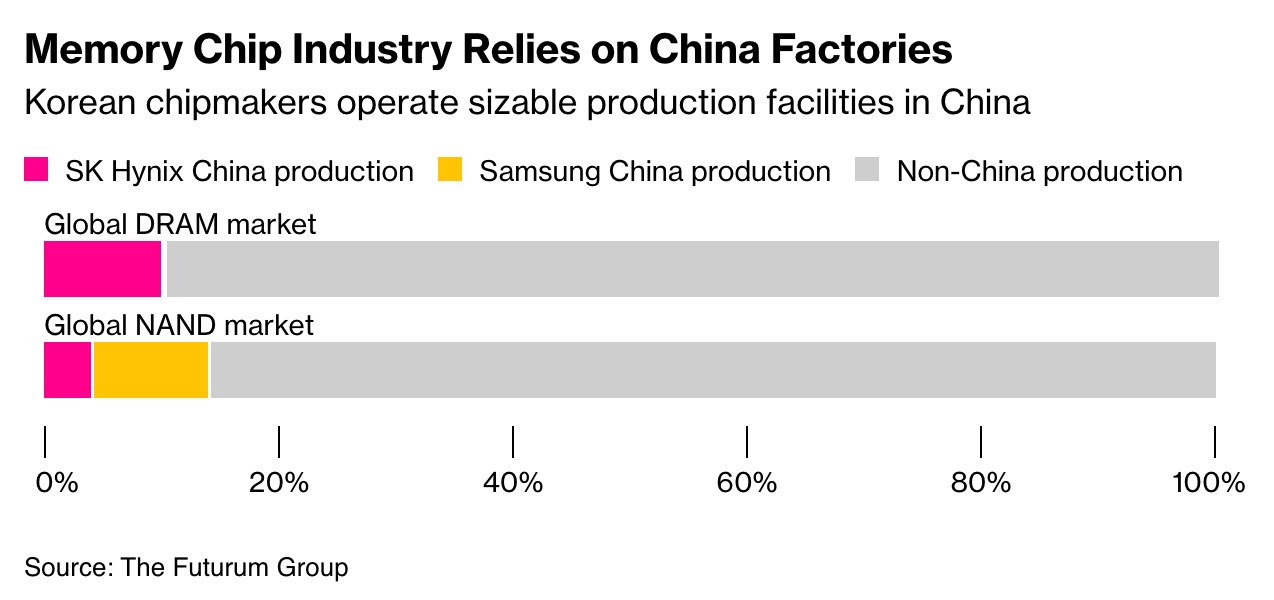
For its part, Trump’s team has explicitly said the US intends to grant the licenses necessary for companies to operate their existing factories in China, without approving any permits that would allow the firms to expand or upgrade those facilities. (To be sure, the companies already all faced limits on manufacturing growth in China, a condition of subsidies they won to build plants on US soil.)
Still, some in the chip industry worry that the sheer volume of licenses required — some 1,000 annually for Samsung and SK Hynix’s China facilities, corresponding to nearly 500 hours of work — could prove challenging to process quickly. Any bureaucratic delays could translate to snags in production, given that export permits are required for certain consumable goods that require regular replenishments. Taiwan’s Ministry of Economic Affairs has warned that while losing TSMC’s VEU waiver won’t hurt overall industrial competitiveness, it will impact that China plant’s “future operational predictability.”
Conversations about the VEU program began earlier this summer, according to people familiar with the talks. Officials at companies — and some within the Trump administration itself — strongly advocated to maintain the waivers, while South Korean officials, who fought hard to secure VEU status for Samsung and SK Hynix in 2023, also raised the issue in broader trade negotiations. But after months of discussions, Washington made its decision clear last week: The VEU designations will expire at the end of this year.
2.
Christian Davies, “Why memory chips are the new frontier of the AI revolution,” FT, 09/03/2025.
For decades, memory chips were the unglamorous end of the semiconductor industry, overshadowed by the logic or processor chips designed and produced by companies such as AMD, Qualcomm, Nvidia and TSMC to conduct calculations and control an electronic device’s operations.
But HBM designs, such as the HBM3E produced at the Icheon factory, are transforming the memory industry. Joon-yong Choi, vice-president and head of HBM business planning at SK Hynix, notes that whereas in conventional dynamic random-access memory (Dram), “cost was prioritised by customers over power and performance, with HBM power and performance are prioritised over cost”.
They are helping developers of so-called large language models alleviate the effects of the “memory wall” — where limitations in storing and retrieving data are an impediment to improving performance — as well as boosting efficiency and lowering costs at thousands of data centres under construction around the world.
HBM chips, which Hynix began developing in 2013, involved stacking layers of Dram units connected by copper wires a tenth of the thickness of a human hair, like a multistorey library with lifts to quickly transport piles of books between floors.
Hynix’s exclusive contract for the material with its Japanese supplier Namics Corporation forced Samsung and Micron to settle for an inferior manufacturing process involving high temperatures and strong forces, both of which can crack the silicon layers and result in a higher failure rate.
Its superior product helped Hynix to secure its position as the principal supplier of HBM chips to Nvidia and allowed it to ride on the US company’s coat-tails as demand for AI chips exploded after OpenAI’s ChatGPT chatbot was released in late 2022.
If the rise of HBM has disrupted the old order at the top end of the memory market, another source of disruption is emerging from below: Chinese memory champion ChangXin Memory Technologies, or CXMT.
CXMT was testing samples of HBM3 products — one generation behind HBM3E — with a target to launch next year. But analysts and industry insiders remain sceptical that, without access to key equipment and materials that are subject to US export controls, CXMT can close the HBM gap in the near future.
“CXMT stockpiled a lot of the equipment it needed before the most recent round of controls,” says Futurum Group’s Wang. “But it cannot access extreme ultraviolet machines, and it is not clear that they have enough equipment to mass produce advanced HBM products at a similar scale to the leading memory players.” He estimates CXMT is “three to four years behind” in HBM development.
While the H20’s processing power is clearly inferior to the H100, its six on-board Samsung HBM3 chips actually provide better memory performance: four terabytes per second of memory bandwidth, compared with 3.4TBps in the H100 and 3.2TBps in Huawei’s flagship Ascend 910c.
Samsung’s HBM4 will also use an advanced processor chip, produced by its own foundry division. A person familiar with its thinking told the FT that as the only company with cutting-edge capabilities in both processor and memory chips as well as advanced packaging — the process of integrating multiple chips closer together — it could offer customers a “one-stop shop”.
3.
Janet Egan, “Selling AI Chips Won’t Keep China Hooked on U.S. Technology,” Just Security, 09/03/2025.
At the heart of the “addiction” theory lies the belief that using American chips creates vendor lock-in, compelling foreign AI developers to remain within U.S. tech platforms and to keep buying American chips. These arguments have some merit. Nvidia’s proprietary networking equipment and stack strongly incentivizes engineers to stay within its ecosystem, having refined its CUDA software platform over nearly two decades into a “strategic moat.” With its vast libraries of pre-written code and supporting tools, CUDA allows developers to leverage the parallel computing capabilities of Nvidia chips. When AI companies build on and develop expertise in Nvidia’s hardware and software ecosystems, it creates a degree of path dependence. This lock-in makes it more likely that each additional dollar of AI investment flows to and strengthens the American — rather than Chinese — AI ecosystem, reinforcing the U.S. lead. Proponents use this argument to justify selling AI chips to China: get the country’s tech sector “hooked” on Nvidia to capture greater market share and redirect Chinese investment toward U.S. AI innovation.
But making China dependent on U.S. technology is not that straightforward. AI chips are more akin to generators than utility companies. Generators are necessary to produce power, but once the generator is running, the manufacturer does not control what is powered with it. Generators can be swapped out for others, combined with local power sources, or integrated into hybrid energy systems. Unlike a utility company that maintains persistent control over electricity supply and pricing, chips are a one-off input — value-neutral hardware that runs whatever code developers choose. Developers may use CUDA today, but they can layer domestic software and tools on American hardware tomorrow. They can gradually integrate these systems with local infrastructure as their domestic ecosystem matures. Beijing has a well-funded national strategy to indigenize chip production, and access to U.S. chips will not meaningfully diminish these efforts. Rather than creating lasting dependence, exporting U.S. chips will simply expedite China’s AI progress as it scales its indigenous chip manufacturing capacity.
The United States’ own AI labs show that reducing reliance on Nvidia’s proprietary ecosystem is not only possible, but already happening. Anthropic originally relied on Nvidia graphics processing units (GPUs) to train its flagship model, Claude, but it has since shifted most of its computing needs to other ecosystems. Today, Anthropic optimizes for training on AWS’s Trainium hardware, while also using a mix of Google tensor processing units (TPUs) and Nvidia GPUs. Google DeepMind followed a similar trajectory.
Switching costs are a significant, but surmountable, engineering challenge that Chinese developers are already planning for. Beijing has signaled that reliance on American AI chips is risky through energy efficiency rules that discourage the use of certain U.S. chips, along with public warnings about their security risks. Similarly, U.S. export controls have already undercut the Chinese AI industry’s perception of U.S. firms as trusted suppliers. Chinese firms will act accordingly to avoid long-term lock-in through investment in indigenization and diversification.
4.
Pablo Chavez, “What the US-EU $40 Billion Chip Deal Means,” CEPA, 09/02/2025.
In the Framework on an Agreement on Reciprocal, Fair, and Balanced Trade, a section centers on two key issues: a European pledge to buy US AI chips and a commitment to align on security safeguards.
At first glance, this looks like a breakthrough: a transatlantic alignment on AI chips, the foundational technology for models, systems, and agents. It projects the image of cooperation in a landscape otherwise marked by friction. But a closer look reveals that both the purchase numbers and the security commitments are provisional, leaving open key questions about scale, timing, and certainty.
Viewed this way, the framework reflects a broad pattern in US trade and technology diplomacy: headline figures first, implementation later.
For Europe, it falls short in two ways: it fails to establish a binding mechanism to fund or allocate $40 billion in chip purchases, and it fails to guarantee supply. For the US, it offers the optics of a significant commitment with limited substance. A final agreement is intended and may settle some of these issues (though the timing and substance of a final deal may be complicated by President Donald Trump’s threat of export restrictions on US AI chips to Europe).
Until then, the practical effect is best described as net neutral, with a real risk of turning negative if new conditions slow European chip purchases.