

Weekly: US-China chip design competition; CXMT and YMTC catch up?; Nvidia status update
8.5 min read.

Highlights
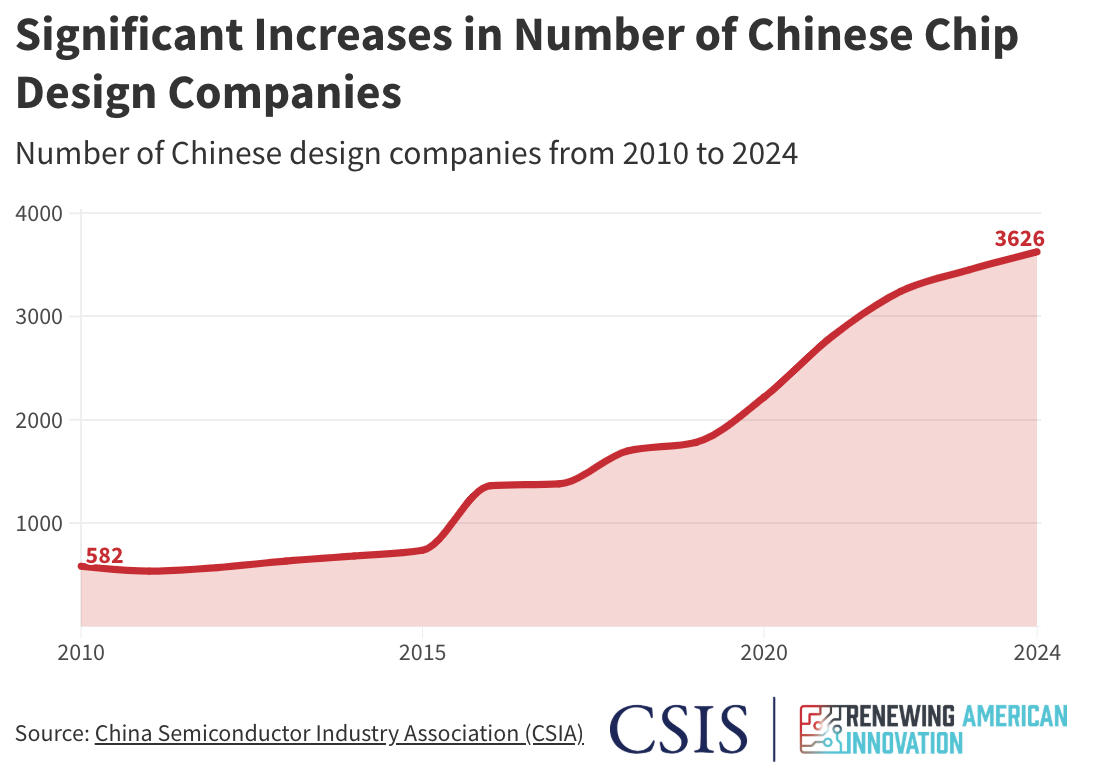
US-China chip design competition. Two reports out of CSIS. One is on China’s explosive growth in chip design companies. The China Semiconductor Industry Association reports some 3,600+ design companies currently in China. The report notes that this growth was fuelled by the China Integrated Circuit Industry Investment Fund (aka Big Fund) and that many of these companies will likely go bankrupt. In any case, China’s chip design industry in undoubtedly growing.
It reminds me of Kai-Fu Lee’s book, AI Superpowers, which argued that China’s innovation was driven by lots of capital invested, and even though the results were mixed, China could still get to where it needed by sheer force of capital, political will, and competitive necessity.
The second CSIS report is a deeper dive into the semiconductor design industry and calls for the U.S. to invest more in the domestic chip design industry.
CXMT and YMTC catch up? I’ve written about the shifting memory chip landscape many times before, and this week an in-depth article from South Korea’s Chosun Daily delves into the latest development. YMTC’s has made technological developments in a particular bonding process, which Samsung and SK Hynix reportedly may licence. Not only are Chinese memory companies offering drastically lower prices (as low as half price), but now it seems that they are making their own technological breakthroughs, which is new. This was how Japan took memory chip market share from the U.S. in the 80s, and then (roughly) how South Korea from Japan in the 90s. History repeats?
So far, the U.S. has focused on export controls, trying to prevent advanced AI chips from entering China. Have they considered import controls / investigations, to manage the flow of Chinese memory companies selling super cheap memory chips to the U.S.? China’s memory market share is still very low (5-15%) but rising rapidly. In 2021, the U.S. banned cotton from the Xinjiang region, so this is definitely part of a menu of policy options.
On Nvidia. A piece on Nvidia in The Economist and one in the WSJ. The Economist’s piece has a more realistic tone, observing that Nvidia faces the twin pressures of US export controls (which may escalate under the Trump admin) and China’s self-sufficiency drive. The WSJ piece is more optimistic, arguing that Nvidia margins are still very high relative to peers, despite a slight dip in the latest earning call. As Big Tech companies make huge investment into AI infrastructure, the piece argues, Nvidia still has a lot of runway left.
Thanks for reading.
Table of Contents
The Economist, “Nvidia is fighting both Trump and China,” The Economist, 02/25/2025.
Dan Gallagher, “Nvidia Is Far From Running Out of Road,” WSJ, 02/26/2025.
Ralph Jennings, “Stay or go? Taiwan’s chipmakers explore US factories to avoid tariffs,” SCMP, 02/26/2025.
Chun Byung-soo and Lee Jae-eun, “Samsung's memory chip leadership at risk as China's CXMT, YMTC close in,” Chosun Daily, 02/27/2025.
Hideki Tomoshige, “Innovation Lightbulb: Innovation Competition in Chip Design Between the U.S. and China,” CSIS, 02/21/2025.
Sujai Shivakumar, Charles Wessner, and Thomas Howell, “Growing Challenges for the Semiconductor Design Industry: The United States Cannot Take Leadership for Granted,” CSIS, 02/25/2025.
1.
The Economist, “Nvidia is fighting both Trump and China,” The Economist, 02/25/2025.
There are two trade-stifling levers the government may pull that would deal a blow to Nvidia. The first is to further limit the sale of GPUs directly to China. When the earlier chip controls took effect, Nvidia produced a scaled-down GPU for sale to the Chinese market, called the H20. The Trump administration is now said to be considering restricting sales of that chip, too. Dylan Patel of SemiAnalysis, a consultancy, believes Nvidia is suspending production of H20s in response to the threat (he says it produced over 1m of them in the nine months to the end of January). The chipmaker is quietly explaining to the American government that the H20 has no more processing power to help China achieve its AI dreams than commonplace gaming chips it sells in the country. That said, the chip’s use in China for AI is reportedly soaring.
The American government’s second lever would prevent Chinese firms from getting access to GPUs via third countries, which is the intention of the Framework for AI Diffusion, an interim rule introduced just days before Joe Biden left office. It aims to halt the illegal smuggling of GPUs to China and stop Chinese firms from getting access to American AI infrastructure via other countries’ server farms. It will take effect in mid-May, unless ditched beforehand.
Mr Huang may still hope to change the president’s mind. Although he is not part of the tech “broligarchy” surrounding Mr Trump, he has good connections.
Geopolitics has already made life difficult for Nvidia in China. American sanctions on Huawei have kneecapped the chipmaker’s strongest competitor in the country, but trade restrictions have hurt the American firm, too. Sales to China as a share of Nvidia’s total are already down from more than a fifth two years ago. Efforts by the Chinese government to stimulate demand for home-grown chips have not helped.
2.
Dan Gallagher, “Nvidia Is Far From Running Out of Road,” WSJ, 02/26/2025.
[Nvidia’s strong earnings] didn’t help Nvidia’s stock price much, though. Shares fell slightly in after-hours trading after having risen nearly 4% in Wednesday’s regular session. Revenue beat Wall Street’s consensus by about $1.2 billion, which is actually the smallest margin since Nvidia’s AI business started booming in early 2023. The company also confirmed that its newest product line—a family of AI chips and full-computing systems branded as Blackwell—will cause a small hit to the company’s gross margin for much of this year.
Investors shouldn’t fret over the latter. Even gross margins in the low-70% range that Nvidia said to expect early in the new fiscal year would be well above that commanded by most other chip companies; the 30 companies on the PHLX Semiconductor Index averaged 51.5% gross margins over the last year, according to data from S&P Global Market Intelligence.
Even more challenging is the rising suspicion among some that AI is a bubble about to pop in spectacular dot-com fashion. Nvidia and other prominent AI names saw their stocks melt down last month after claims from a Chinese AI startup called DeepSeek raised questions about the computing costs really needed to train advanced AI models.
The massive piles of cash that tech giants plan to pour into capital spending on AI this year should ease some of those fears. Beyond that, Nvidia will need to show how it can keep building on the strong lead it already has.
3.
Ralph Jennings, “Stay or go? Taiwan’s chipmakers explore US factories to avoid tariffs,” SCMP, 02/26/2025.
To push chipmakers to shift production to the US, Trump has threatened to slap tariffs of 25 per cent on shipments of foreign-made semiconductors – and introduce even higher duties if necessary.
Given that advanced chips underpin everything from artificial intelligence to advanced weaponry, the US’ reliance on Taiwan is a strategic vulnerability. It is also expensive.
But the prospect of steep US tariffs is now forcing companies across Taiwan to make a difficult decision: set up expensive new American factories, or look for other ways to cope with the higher duties.
Policymakers and businesses in Taiwan have taken pains to show they are responding to Trump’s agenda in recent weeks, with TSMC playing a leading role.
The world’s largest contract chipmaker has invested heavily to set up a new plant in Arizona, which recently started producing the firm’s advanced 4-nanometre chip.
On February 14, Taiwan’s leader William Lai Ching-te pledged to step up government support for Taiwanese companies to increase their investment in the US, and to strengthen communication with Washington on semiconductors to allay Trump’s “concerns”.
In reality, Taiwanese companies have already increased their investments in the US electronics industry over the past few years, as they seek to align with Washington’s agenda, Moody’s Analytics noted earlier this month.
However, Taiwan’s many smaller chipmakers would find it relatively expensive to run fabs in the United States, analysts said. Land and labour can be prohibitively expensive.
4.
Chun Byung-soo and Lee Jae-eun, “Samsung's memory chip leadership at risk as China's CXMT, YMTC close in,” Chosun Daily, 02/27/2025.
Samsung’s device solutions division, which oversees semiconductors, is struggling to develop next-generation memory products and advanced process technologies, according to sources familiar with the matter on Feb. 27. The company is reportedly set to use a hybrid bonding patent from YMTC for its upcoming 400-layer V10 NAND. Hybrid bonding is a technology that bonds wafers together without using bumps, which traditionally serve as intermediaries between layers.
In the high-end DRAM segment, Samsung is redesigning its sixth-generation 10nm-class (1c) DRAM, while the development of the next-generation seventh-generation (1d) DRAM is reportedly facing challenges.
Samsung’s decision to use YMTC’s hybrid bonding patent has raised concerns that YMTC has gained a technological edge over Samsung in next-generation semiconductor manufacturing technology. Until recently, YMTC was a minor player in the NAND flash market, while Samsung dominated with a 35.2% share as of the third quarter of last year, followed by SK Hynix at 20.6%. YMTC’s share remained below 5%.
But YMTC’s hybrid bonding technology has shifted the market dynamic. While Samsung and SK Hynix focused on refining conventional stacking methods, YMTC prioritized the commercialization of hybrid bonding for 3D NAND, branded as “Xtacking.”
The technology has emerged as a key process innovation as conventional stacking methods face limitations, with NAND layer counts now exceeding 400 layers. Samsung Electronics and SK Hynix are mass-producing NAND with 286 and 321 layers, respectively.
5.
Hideki Tomoshige, “Innovation Lightbulb: Innovation Competition in Chip Design Between the U.S. and China,” CSIS, 02/21/2025.
China is the U.S.’s primary competitor in chip design. In 2024, China's chip design industry achieved sales of $90.99 billion, increasing 11.9% from 2023. One of the key contributors to this growth was the China Integrated Circuit Industry Investment Fund Phase I and II, which have committed billions of dollars to fabless design companies and integrated device manufacturers. The Fund’s Phase III is operating on an even larger scale, further fueling China's semiconductor design industry.
Chinese design companies including Huawei's HiSilicon Technologies, the most profitable and innovative fabless private semiconductor company, Will Semiconductor, Hygon Information Technology, and Giga Device Semiconductor have all increased their sales. Although Chinese design industry sales grew 11.9%, the total sales of China's top 10 design firms in 2024 were down 3.7% from 2023. This number suggests that these top companies are the tip of the iceberg when it comes to the number of growing Chinese design companies, as China is one of world's number of chip design companies in the world.
As the graph above from the China Semiconductor Industry Association (CSIA) shows, there were 3,626 chip design companies in 2024, up more than 175 compared to the previous year. At the same time, 20 percent of design companies exceeded 100 million yuan in sales, more than 106 additional firms compared to 2023. Many of these companies probably will go bankrupt. Despite this, the overall growth in the number of firms highlights China’s growing design industry.
6.
Sujai Shivakumar, Charles Wessner, and Thomas Howell, “Growing Challenges for the Semiconductor Design Industry: The United States Cannot Take Leadership for Granted,” CSIS, 02/25/2025.
If an adversary could design and deploy chips more advanced than those in use by the United States, it could win a commanding advantage in every aspect of military preparedness, up to and including a major conflict. In global competition for high-tech industry, there is arguably no parallel for the sheer scale of China’s commitment of public resources to the semiconductor industry.
U.S. policymakers need to recognize the strategic importance of the chip design sector and the unprecedented challenges it faces. To realize the new Trump administration’s goal of sustaining U.S. technology leadership in semiconductors, doubling down on support, backed by substantial and sustained investments and incentives, is essential.